Get

In Your Inbox

Dogster is reader-supported. When you buy via links on our site, we may earn an affiliate commission at no cost to you. Learn more.

How Big Is a Spay Incision? Vet-Reviewed Health Facts

Share

Closeup of a sutured incision on a young dog's lower abdomen a day after spay surgery

If you’re considering getting your dog spayed, you’re on the right track. There are numerous health and behavioral benefits to the procedure, but what can you expect when you bring your dog home?

The exact size of the incision will vary depending on the type of spay surgery they get, ranging from two small incisions about 1/5th of an inch in size, all the way up to one incision that is 4 inches long. We’ve highlighted everything you need to know below so you can determine exactly what will happen to your dog and how big their spay incision is likely to be. However, if you want a direct answer, just reach out to the vet who will perform the surgery.

divider dog paws 3 oct 2024

Traditional Spay Incision Size

If your dog is undergoing a traditional spay surgery, you can expect the incision to be between 2 and 4 inches long, depending on the size and age of your pup. Often, the larger your dog, the larger the surgical incision will be.  Bear in mind that each vet will make a different sized incision, and this is due to their surgical preference.  In dogs with deeper abdomens, the wound may have to be larger to allow the veterinary surgeon to access and remove the ovaries.

The ideal time to spay a dog depends on their breed.1 In most small breeds, you usually need to wait until they’re at least 6 months old before the surgery, but this depends on your vet’s preference.  Larger breeds vary in terms of ideal timings.  Thankfully, traditional spays are readily available at most veterinary hospitals and are fairly affordable.

If the size of a 2- to 4-inch incision is a bit much for you, you could opt for a laparoscopic spay instead, which is more expensive but less invasive.
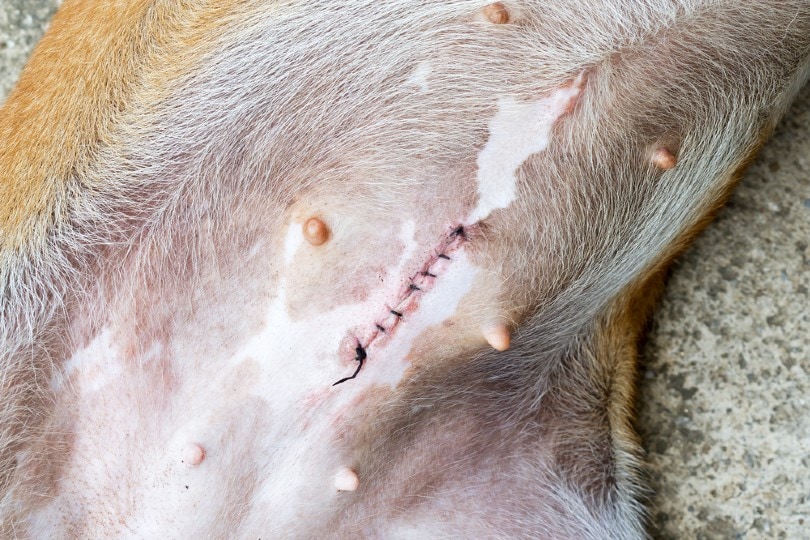
spaying stitches of a dog
Image Credit: supersaiyan3, Shutterstock

Laparoscopic Spay Incision Size

While a traditional spay incision is between 2 and 4 inches long, a laparoscopic spay incision is much smaller. With a laparoscopic spay, there are two incisions made. Each incision is between 1/5th to 2/5th of an inch long.  The surgery is less invasive and leads to less trauma and post-operative discomfort. Some other benefits include less bruising at the surgical sight, smaller wounds to manage, quicker recovery and fewer complications from surgery. It is important to note that in a laparoscopic spay, only the ovaries are removed.  The uterus is left in, but this should cause no problems as long as both ovaries are removed completely.

Each vet has their own preferences, and it’s best to follow their advice when it comes to surgery.

Dogster divider_v3_NEW_MAY_24_

Is Spay Surgery Painful?

No matter how you look at it, spay surgery isn’t a pleasant experience for your pup. It’s a surgery that involves exterior incisions and procedures happening inside your dog’s body, which are painful to recover from.

This is why veterinarians can and should prescribe pain medications for your dog while they’re recovering. And keep in mind that while the surgery is painful, there are numerous health benefits that make it more than worth it (in all breeds except Golden Retrievers)2 in the long run.

The Spay Surgery Process

You’re welcome to use our images, but we require you link directly to this site for credit (ex. Image from Dogster)

If you’re like us, you want to have all the information possible before making a decision, which is why we wanted to give you a brief rundown of the surgical process. However, if you have any questions, they should always be directed to the vet who will be performing the surgery.

The process begins with your vet completing some routine bloodwork to ensure your pet is ready for surgery. Next, the vet uses a sedative to reduce your pet’s anxiety and give some preemptive pain relief, before placing them under general anesthesia.

The veterinary nurses then prepare and stabilize the patient.  This includes preparing the area for surgery by clipping hair and sterilizing the skin, monitoring the breathing rate and heart rate of your dog, amongst other parameters.  Once the patient is prepared, the veterinary surgeon will make their incision just below the belly button.  This incision will go through the skin but also through the muscle layers of your dog’s abdomen.  The vet will then locate and remove the reproductive tract, which includes the uterus, and both ovaries. They then close the incision with two layers of stitches under the skin that will dissolve over time. The skin can be closed with stitches (which are often self-dissolving and may or may not be visible), or skin staples.

The vet then administers more pain medication so they wake up in a little less pain, and the recovery process begins!

veterinarian spaying or neutering a dog
Image Credit: RJ22, Shutterstock

Advantages of Spaying Your Pet

There are numerous advantages to spaying your pet, including preventing accidental puppies. Another advantage is that you don’t need to worry about spotting around your home, which can be messy and unsanitary. On top of that, spaying can help protect your dog from future diseases, like uterine infections and breast cancer. Behavioral benefits of spaying can include a reduction in humping, roaming, and inter-dog aggression.

divider dog paws 3 oct 2024

Final Thoughts

Now that you know a little more about the spaying process and why it’s beneficial for your pooch, all that’s left is for you to reach out to your vet and schedule an appointment. While it might be scary for you and your dog, it’s the best thing for them in the long run! If you do have a female Golden Retriever, it is best to speak to your vet about when and if you want to spay her at all.


Featured Image Credit: Sari ONeal, Shutterstock

Want content like this delivered to you?

Sign Up For Our Newsletter

News, insights, expert advice, and everything dog

* By submitting, you agree to our Terms & Conditions and Privacy & Cookies Policy.


How useful was this post?

Click on a star to rate (you can leave written feedback after clicking submit)

Help us improve Dogster for pet parents!

Your feedback really matters.

What did you like about this post? Also how can we improve it?

Join the conversation

Leave a Reply

You’re very welcome to leave a comment or question. Please know that all comments must meet our community guidelines, and your email address will NOT be published. Let’s have a positive and constructive conversation.


Dogster's Digital Magazine is Back!​

Dogster Magazine Cover June 2026

Vet-approved health & behavior advice

Real dog stories & community features

Ask Dr. Paola- Help! My Vet Suggests a Biopsy for My Dog! (June 15, 2026)

Welcome to our “Ask Dr. Paola” series, where every Monday we bring expert advice straight from Dr. Paola Cuevas (MVZ) to help our...

Why Some Dogs Treat Mealtime Like Playtime – And When to Pay Attention

Most dogs are reliable eaters. Bowl goes down, food disappears. So when a dog starts batting kibble across the kitchen floor, tossing pieces...

Major Win for Dogs: Ontario Becomes the Final Province to Ban Ear Cropping and Debarking

​​Ontario has approved new animal welfare regulations that will prohibit elective ear cropping and devocalization (debarking) procedures in dogs from January 1, 2027....

Dogster’s Weekly Photo Contest Winners: Most Adorable Puppy (June 8, 2026)

Every week our team gets the privilege of sorting through our readers photos to choose what dogs will win this weeks contest! See...

More related

World Rabies Day 2026: When & What Is It?

World Rabies Day might sound like a fresh new phrase you’ve never heard before, but this holiday has been in motion since 2007....

Why Is My Dog’s Poop Dry & Powdery? 12 Vet-Reviewed Causes (With Pictures)

As gross as it may sound, your dog’s poop can tell you a lot about its health. Healthy dog stools should be moist...

Havapoo vs. Maltipoo: The Main Differences (With Pictures)

Havapoos and Maltipoos are mixed breeds created to have the best characteristics of each parent. Both are Poodle mixes, with Maltipoos having one...

Do Dogs & Bunnies Get Along? 6 Tips on Living With Them Both

Dogs and bunnies are unlikely friends, but it’s not impossible for these two pets to live together. When the conditions are right, they...

Keep reading

Can Dogs Eat Anise Seed? Vet-Approved Benefits & Risks

Dogs can eat anise seed, and the strong-smelling spice is known to be the canine version of catnip. It can be used as a fun, stimulating treat for training or as a natural remedy. Before feeding anise seed to your...

Can Dogs Eat Anise Seed

Orijen Dog Food vs Blue Buffalo Dog Food: 2026 Comparison, Pros & Cons

With so many dog food options on the market, it’s easy to walk away with your hands empty and your head buzzing. If you’ve been buying dog food for some time or have recently adopted a puppy and have been...

Dogster_Dog Food Orijen VS Blue Buffalo

Can Dogs Eat Tahini? Vet-Verified Facts & FAQ

Tahini is delicious, rich, and wholesome! You can find sesame seed paste in many cuisines worldwide, like those in the Middle East, Israel, China, Africa, Japan, Turkey, Iran, and Korea. In addition to providing several vitamins and minerals, tahini is...

Can Dogs Eat Tahini

Royal Canin vs Kirkland Dog Food: 2026 Comparison, Pros & Cons

Finding a dog food that’s a great fit for your four-legged friend is a struggle. There are so many brands available, so many ingredients, so much confusion…the list goes on. So, how does a dog owner know which dog foods...

Dogster_Dog Food Royal Canin vs Kirkland

Gravy Train Dog Food Review 2026: Recalls, Pros & Cons

Review Summary The best way to a dog’s heart is through their stomach, and feeding them nutritional and tasty food is a surefire way to make you their favorite person. Finding a brand that you and your dog likes can...

Dogster_Gravy Train Dog Food Review

Taste of the Wild Dog Food Review 2026: Recalls, Pros & Cons

Review Summary Taste of the Wild is a pet food brand owned by Diamond Pet Foods, which has its headquarters in Meta, Missouri. The brand’s mission is to create nutrient-packed, affordable cat and dog food that mimics their wild ancestor’s...

Dogster_Taste of the Wild High Prairie Puppy Food Review

11 Best Dry Dog Foods for Small Dogs in 2026 – Reviews & Top Picks

If you’re the proud owner of a tiny dog, you know that they have specific food requirements. They have faster metabolisms, grow faster, and have smaller stomachs and mouths than larger breeds. All of this means that not only are...

Purebred Dachshund Breed Dog Eating Fresh Dry Food Kibbles

11 Best Dry Dog Foods for Large Dogs in 2026 – Reviews & Top Picks

The market is flooded with hundreds of different dog food brands, all of which are advertising that they’re the healthiest and best fit for your dog. Finding a good brand of dog food is a challenge regardless of what type...

blue fawn pitbull eatin dry kibble from a bowl

Love Dogs? So Do We! Join the Dogster Community

Stay informed with expert pet care insights delivered straight to your inbox! Discover professional guidance on animal behavior, feeding tips, trusted product picks, and much more.


Sign up for the Dogster Email Newsletter